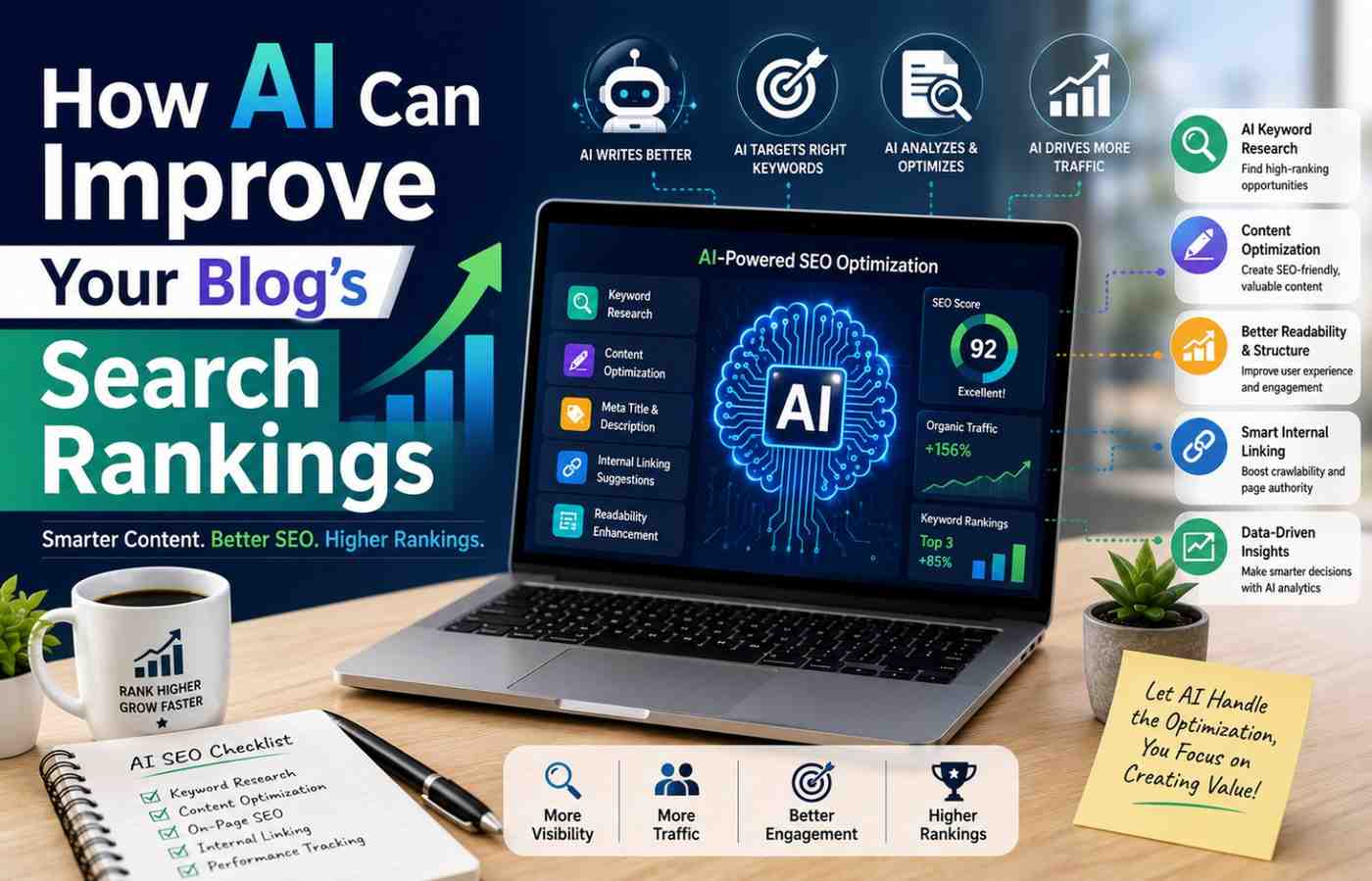
How AI Can Improve Your Blog’s Search Rankings
Ranking on Google has become more competitive than ever. Millions of blog posts are published every day, making it increasingly difficult for new and existing bloggers to stand out. Simply writing good content is no longer enough—you also need to understand what your audience is searching for and how search engines evaluate content.
This is where Artificial Intelligence (AI) is transforming online blogging. AI-powered tools help bloggers research keywords, analyse competitors, optimise content, improve technical SEO, and create a better experience for readers. Rather than replacing human writers, AI acts as a smart assistant that makes the blogging process more efficient and data-driven.
Whether you run a personal blog or publish articles on fsiBlog, a multi-blogging platform, understanding how AI supports SEO can help you increase organic traffic while maintaining high-quality, original content.
Why AI Matters for Modern SEO
Search engines have become much smarter. Google’s algorithms now evaluate content based on relevance, user intent, experience, expertise, authority, and trustworthiness (E-E-A-T). They also consider user engagement, page experience, and overall content quality.
AI helps bloggers adapt to these changing requirements by identifying opportunities that may be difficult to discover manually. Instead of guessing which topics might perform well, AI analyses patterns in search behaviour and provides data-backed recommendations.
The result is content that is more likely to satisfy both search engines and readers.
Smarter Keyword Research
Keyword research remains one of the most important aspects of SEO, but AI makes the process faster and more accurate.
AI tools can identify:
- High-volume keywords
- Low-competition opportunities
- Long-tail keywords
- Question-based searches
- Semantic and related keywords
- Seasonal search trends
For example, instead of targeting only AI for Blog SEO, AI may suggest related searches such as:
- AI tools for bloggers
- AI content optimisation
- Improve blog rankings
- AI keyword research
- SEO blogging tips
- Online blogging strategies
Using these naturally throughout your article helps search engines understand the topic more comprehensively.
Better Content Planning
One of the biggest reasons blogs fail to rank is poor content strategy.
AI can help create an effective content plan by:
- Finding content gaps
- Suggesting pillar pages
- Building topic clusters
- Identifying trending subjects
- Recommending internal linking opportunities
Instead of publishing unrelated articles, bloggers can build an organised content library that strengthens topical authority.
For instance, if your main niche is online blogging, AI may recommend supporting articles on keyword research, content marketing, AI writing tools, blogging mistakes, and SEO best practices. Together, these articles reinforce your expertise.
Optimising Content for Search Intent
Google wants to display pages that best answer a user’s question. AI helps identify the intent behind search queries, whether users are looking to learn, compare, purchase, or solve a problem.
By understanding search intent, bloggers can:
- Structure articles more effectively
- Answer common questions
- Include practical examples
- Improve readability
- Cover related subtopics
Content that closely matches user intent is more likely to achieve higher rankings and longer engagement.
Creating SEO-Friendly Headlines
Your headline influences both click-through rates and search visibility.
AI can generate multiple title variations that include target keywords while remaining natural and engaging.
For example:
- How AI Can Improve Your Blog’s Search Rankings
- AI SEO Tips Every Blogger Should Know
- Improve Blog Rankings with Smart AI Strategies
- The Ultimate Guide to AI for Blog SEO
A compelling title encourages more users to click your article from search results.
Improving On-Page SEO
AI tools simplify many on-page SEO tasks that previously required manual effort.
They can recommend improvements for:
- Title tags
- Meta descriptions
- Heading structure
- Image alt text
- Keyword placement
- Internal links
- External references
- URL slugs
Rather than overusing keywords, AI encourages natural optimisation that enhances readability while improving search relevance.
Enhancing Content Quality
Search engines reward useful and comprehensive content.
AI can help by identifying:
- Missing topics
- Weak paragraphs
- Repetitive sentences
- Grammar issues
- Readability improvements
- Content depth
However, the final article should always be reviewed by a human writer. Adding personal experience, original insights, and real-world examples ensures your content remains authentic and valuable.
Strengthening Internal Linking
Internal links help both readers and search engines navigate your website.
AI can suggest relevant articles to link together, creating a logical structure across your blog.
For example, an article about AI SEO might link to posts on:
- Keyword research
- Content writing
- Blogging tools
- Technical SEO
- Content marketing
- Link-building strategies
A strong internal linking strategy improves crawlability and keeps readers on your website longer.
Technical SEO Made Easier
Many bloggers struggle with technical SEO because it involves website performance and backend optimisation.
AI-powered tools can identify issues such as:
- Broken links
- Slow-loading pages
- Missing meta tags
- Duplicate content
- Mobile usability problems
- Image optimisation opportunities
Fixing these technical issues can improve both search rankings and user experience.
AI Helps Analyse Competitors
Understanding why competitors rank highly provides valuable insights.
AI can analyse competing pages and highlight:
- Frequently covered topics
- Keyword usage
- Heading structure
- Content length
- Backlink opportunities
- Common user questions
This information helps you create more complete and useful articles rather than simply copying what already exists.
Boosting User Engagement
Google pays attention to user behaviour. While it does not use every engagement metric directly as a ranking factor, positive user signals often reflect valuable content.
AI can improve engagement by helping you create:
- Clear introductions
- Well-organised headings
- FAQ sections
- Short paragraphs
- Easy-to-read language
- Actionable advice
Readers who stay longer, explore more pages, and return to your site contribute to stronger long-term performance.
Supporting Content Updates
SEO is not a one-time task. Older articles should be refreshed regularly.
AI helps identify outdated information, recommend new keywords, and suggest additional sections based on current search trends.
Updating existing content is often quicker than creating entirely new articles and can lead to significant improvements in rankings.
Combining AI with Human Expertise
Although AI is a powerful assistant, it cannot replace genuine experience or creativity.
The most successful bloggers use AI to:
- Research keywords.
- Generate content ideas.
- Build article outlines.
- Improve grammar and clarity.
- Optimise SEO elements.
- Analyse performance.
They then add:
- Personal insights
- Practical examples
- Industry knowledge
- Original research
- Unique opinions
This combination creates content that is informative, trustworthy, and difficult to replicate.
Publishing on the Right Platform
Even the best content needs the right platform to reach readers.
Publishing on fsi Blog, a multi-blogging platform, allows creators to share SEO-friendly articles across a variety of niches, including technology, education, business, health, finance, and digital marketing. When paired with AI-assisted optimisation and high-quality human writing, bloggers can improve discoverability while maintaining originality.
Remember, sustainable SEO success comes from consistently delivering valuable content that answers real questions—not from relying solely on automation.
Common Mistakes to Avoid
Avoid these common errors when using AI for SEO:
- Publishing AI-generated content without editing
- Stuffing articles with keywords
- Ignoring search intent
- Overlooking technical SEO issues
- Skipping fact-checking
- Using generic or repetitive language
- Forgetting to update older posts
- Focusing on search engines instead of readers
Balancing AI efficiency with human judgement leads to stronger long-term results.
Conclusion
Artificial Intelligence is reshaping the future of blogging by making SEO more accessible, efficient, and data-driven. From keyword research and content planning to technical optimisation and performance analysis, AI helps bloggers make informed decisions that improve search visibility.
However, the most successful strategy combines AI with human creativity. Use AI to streamline repetitive tasks, uncover opportunities, and refine your work—but rely on your own expertise, experiences, and unique perspective to create content that readers genuinely value.
As search engines continue to prioritise helpful, trustworthy, and user-focused content, bloggers who blend AI-powered insights with authentic writing will be best positioned to achieve sustainable rankings and long-term audience growth.
Frequently Asked Questions (FAQs)
1. Can AI really improve my blog’s search rankings?
Yes. AI can support keyword research, content optimisation, technical SEO, internal linking, and content updates, helping you create articles that better align with search intent.
2. Will Google rank AI-assisted content?
Google evaluates content based on quality, usefulness, and originality rather than whether AI was involved. Human review and added expertise remain essential.
3. Which SEO tasks can AI automate?
AI can assist with keyword research, headline generation, meta descriptions, readability analysis, internal linking suggestions, technical SEO checks, and content planning.
4. Is AI a replacement for human writers?
No. AI is best used as a productivity tool. Human creativity, experience, and critical thinking are still needed to produce authoritative and engaging content.
5. What is the best way to use AI for blogging?
Use AI to research topics, generate outlines, optimise SEO elements, and refine drafts, then personalise the content with your own examples, insights, and expertise before publishing.